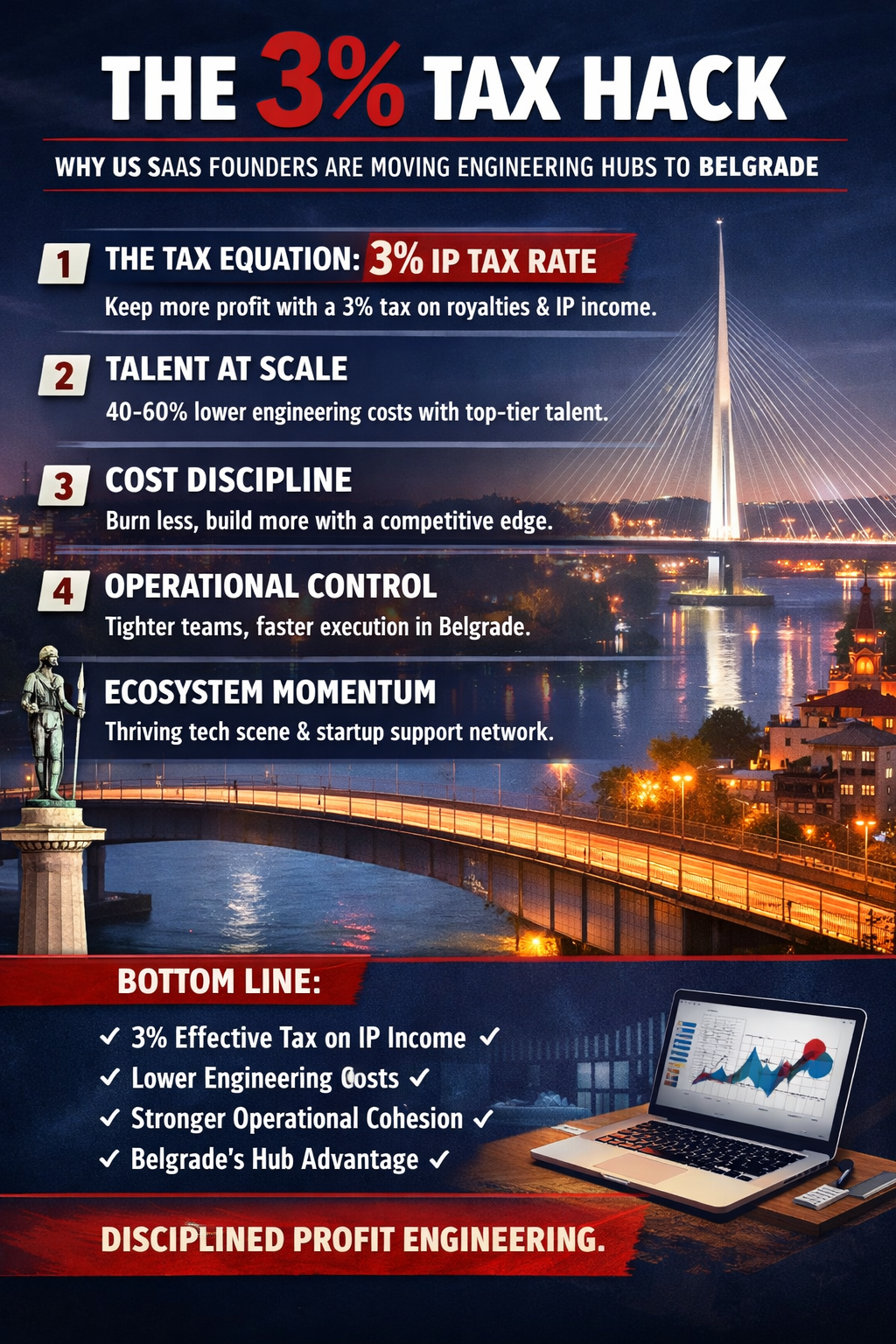
Trump’s 2026 Trade War Reset: Why U.S. Founders Are Quietly Moving Operations to Serbia
The Global Reset Nobody Is Talking About Yet
US founders moving operations to Serbia are not reacting to headlines; they are responding to operational risk created by Trump’s 2026 tariff reset and global trade uncertainty.
The real impact hit operations.
According to policy signals published directly by the U.S. administration at https://www.whitehouse.gov, tariff escalation is no longer a temporary tactic but a long-term economic lever. That shift triggered currency volatility, stricter banking compliance, and increased scrutiny on U.S.-domiciled entities operating internationally.
For SaaS founders, agencies, and digital businesses, the question quietly shifted from growth to resilience.
Where do you operate when political risk becomes operational risk?
That is where Serbia entered the conversation.
Why Tariffs Hit Digital Businesses Harder Than Manufacturing
Digital founders often assume trade wars are irrelevant to them. No containers, no ports, no customs. That assumption is wrong.
Trade policy shifts influence financial systems faster than logistics. As reported by the Financial Times https://www.ft.com, global banks recalibrate risk models immediately during trade conflicts, especially for U.S.-linked entities sending frequent cross-border payments.
Three operational consequences follow.
First, banking risk models tighten. U.S. companies paying international contractors or running distributed teams suddenly face slower payments, enhanced KYC, and account reviews.
Second, enterprise customers become risk-averse. Large U.S. and EU buyers increasingly prefer vendors with stable regional operational footprints rather than purely U.S.-registered entities exposed to policy swings, a trend tracked by OECD trade and investment analysis https://www.oecd.org.
Third, compliance costs rise. IRS reporting, transfer pricing scrutiny, and cross-border payment audits increase during periods of trade tension, as documented by EU trade authorities https://ec.europa.eu/trade.
This is why founders are not panicking publicly, but restructuring quietly.
Serbia’s Strategic Advantage in a Fragmented Global Economy
Serbia is not a tax haven. That is precisely why it works.
Unlike aggressive offshore jurisdictions flagged by regulators, Serbia operates within recognized European legal frameworks while remaining outside EU political retaliation mechanisms. This neutrality is why it consistently appears in OECD investment neutrality discussions https://www.oecd.org.
Key advantages that matter in 2026.
A flat 15% corporate tax rate with transparent legislation, not incentive schemes that disappear after one budget cycle.
Strong double taxation treaties, including a comprehensive agreement with the United States, which reduces withholding uncertainty for U.S. parent companies.
Operational neutrality. Serbia is not targeted in trade disputes, which keeps correspondent banks and EU counterparties comfortable.
Access to high-quality engineering and operations talent at costs that remain stable compared to Western Europe, where labor markets are increasingly constrained according to European Commission economic data https://ec.europa.eu.
This is not a theory. This is why Serbia is increasingly used as an operational anchor rather than a shell entity.
Why Founders Are Moving Operations, Not Headquarters
Smart founders are not redomiciling their entire company. That creates unnecessary tax and legal exposure.
Instead, they are splitting structure from substance.
The U.S. entity remains the parent or sales vehicle.
Serbia becomes the operational core.
Engineering teams, finance operations, customer support, and regional management move under a Serbian entity with real payroll, real leases, and real decision-making authority.
This approach aligns with substance requirements increasingly enforced by banks and regulators, a shift highlighted in global financial risk reviews by the BIS https://www.bis.org.
Banks see substance. Regulators see logic. Customers see stability.
The Operational Substance Rule Is the Real Driver
What changed in the last eighteen months is enforcement.
Banks, payment processors, and advertising platforms now demand operational substance. Not virtual offices, not nominee directors, not paper entities.
Guidance from institutions such as the European Central Bank https://www.ecb.europa.eu and compliance frameworks from the Financial Action Task Force https://www.financialactiontaskforce.org have tightened expectations around where value is created and managed.
Serbia makes compliance achievable without burning capital.
You can build a real operation at a fraction of Western Europe’s costs while staying within accepted regulatory frameworks.
That is why founders who understand risk act before headlines catch up.
Why SerbiaOps Exists in This Moment
Most firms sell registrations. That no longer solves the problem.
Founders need orchestration.
Entity setup aligned with U.S. tax exposure.
Banking structures that survive enhanced scrutiny.
Hiring strategies that create real substance, not cosmetic headcount.
Processes that withstand audits, platform reviews, and investor due diligence.
SerbiaOps exists to execute this shift, not to file forms, but to rebuild operational architecture under real-world conditions.
The Quiet Move Is the Smart Move
Trade wars are loud. Smart operators are quiet.
By the time this trend becomes mainstream content, banking access, talent pools, and compliant operational structures will already be locked in.
Serbia is not a loophole. It is a hedge.
And in 2026, hedging operational risk is no longer optional.