Serbia vs Estonia vs UAE is the comparison every serious founder runs before committing to a jurisdiction. When you stack Serbia vs Estonia vs UAE side by side, the differences go far deeper than tax rates. Estonia sells the e-Residency dream. UAE sells tax-free income. Serbia delivers a real operational base in Europe.
The right answer depends entirely on what you are building, where your people are, and what your cash flow looks like. Here is the honest comparison with real 2026 numbers.
The right answer depends entirely on what you are building, where your people are, and what your cash flow actually looks like. Here is the comparison done honestly, with real numbers.
Estonia: The Digital Promise vs The Banking Reality
The e-Residency brand is strong. However, the reality in 2026 is considerably more nuanced than the marketing suggests.
Due to tightening economic substance rules in 2026, a poorly structured Estonian company can face both bank rejections and significant tax risks. (Source: https://www.leapin.eu/blog/e-residency-company-problems) Furthermore, traditional banks in Estonia rarely open accounts remotely, while fintech services such as Wise or Paysera have limited functionality and may not be suitable for certain types of businesses.
On the tax side, the VAT in Estonia is 24% since July 2025, and corporate income tax rates are 22%, set to increase to 24% in 2026. (Source: https://taxsummaries.pwc.com/estonia/corporate/taxes-on-corporate-income) The 0% on retained profits sounds attractive. In practice, however, founders pulling salary or dividends face a materially higher effective rate than advertised.
On average, accounting services for small Estonian businesses cost between 150 and 300 euros per month, making it more expensive to operate than in many other EU countries.
Best for: Digital product companies with EU clients, solo founders with clean and easily traceable income, and entrepreneurs comfortable relying on fintech rather than traditional banking.
UAE: The Tax-Free Dream vs The Real Cost Base
Zero corporate tax on qualifying income is a powerful headline. Nevertheless, the full picture looks considerably different once you account for operational costs.
The total investment for a free zone company setup in Dubai typically ranges from AED 15,000 to AED 50,000 for a basic low-visa-quota package, but can easily exceed AED 100,000 for setups requiring premium office space and multiple visas. (Source: https://www.comparemymove.com/guides/dubai-freezone-setup-costs) Additionally, bank account minimum balance requirements can range between AED 50,000 to AED 200,000 depending on the bank. (Source: https://www.emiratesnbd.com/en/business-banking)
Beyond setup costs, Dubai is an expensive city to operate in. Salaries, office space, and cost of living are all significantly higher than in Central and Eastern Europe. For founders whose clients and operations are primarily in Europe or the US, the time zone friction adds another layer of cost that rarely appears in setup guides.
Best for: Founders who are genuinely relocating their lives to the UAE, whose revenue originates outside the EU, and who can comfortably absorb the ongoing operational cost of a real presence in Dubai.
Serbia: The Real Operational Base in Europe
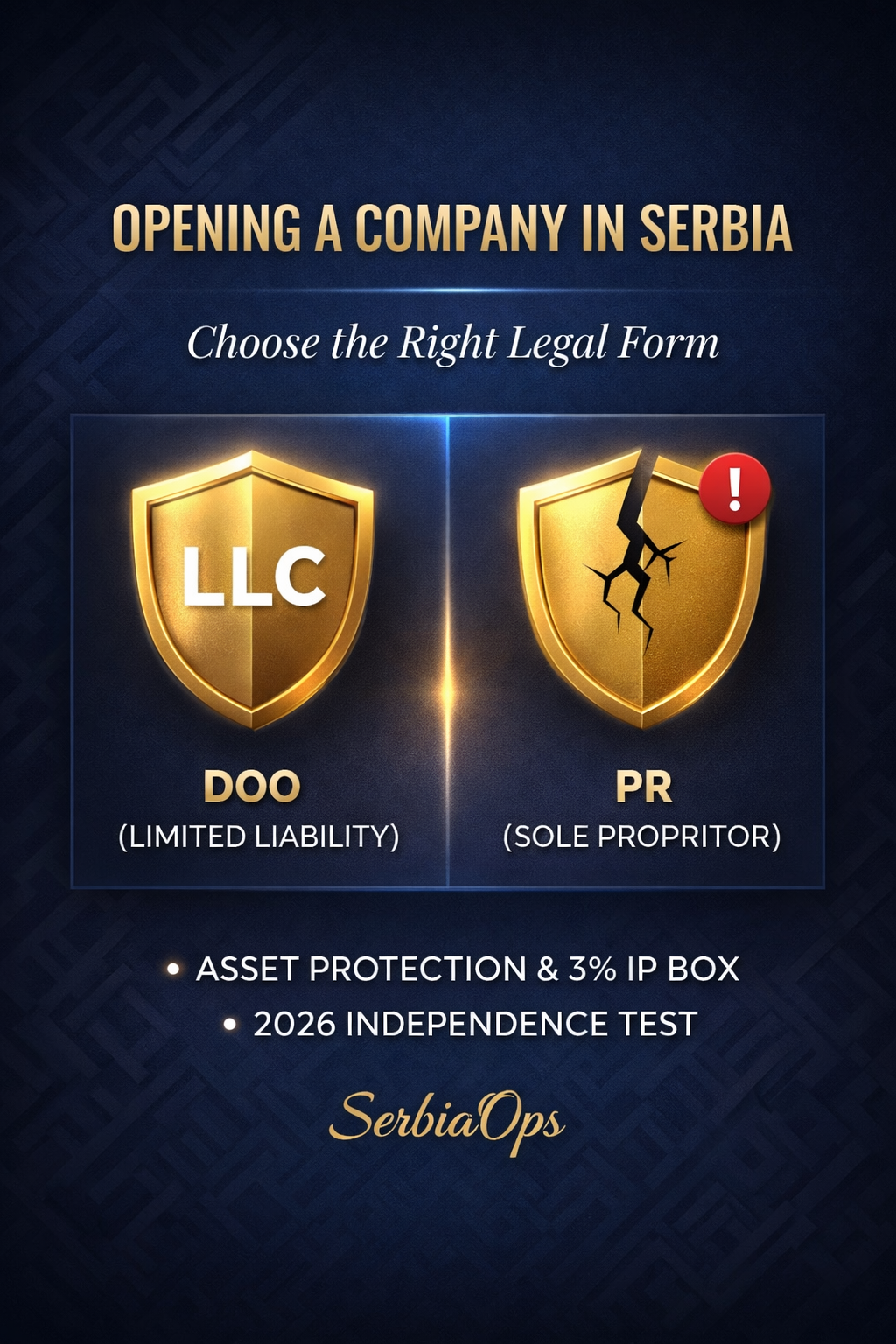
Serbia’s corporate tax rate is a flat 15%, confirmed by PwC and among the lowest in Europe. (Source: https://taxsummaries.pwc.com/serbia/corporate/taxes-on-corporate-income) In addition, there is no minimum founding capital requirement for a DOO, the Serbian equivalent of an LLC. Entity formation takes 5 to 10 business days when executed correctly. Furthermore, total employer costs stand at roughly 50% of Eastern European EU levels, according to the Serbian Development Agency. (Source: https://ras.gov.rs/en/invest-in-serbia/why-serbia/competitive-operating-costs)
Unlike Estonia, Serbia offers a genuinely operational base. You can hire locally, lease real office space, manage payroll compliantly, and bank with traditional institutions without the substance rules that are tightening across the EU. Unlike the UAE, you operate within a European legal framework, in a European time zone, at a European cost base that actually makes sense for companies serving EU and US clients.
The catch is that Serbia is not self-service. You cannot click through a portal and have a functioning company. You need someone who knows the system end-to-end.
Best for: Founders who want a real, operational European base, who plan to hire locally, and who want the lowest compliant tax structure available without the ongoing cost burden of a UAE presence.
Serbia vs Estonia vs UAE: The Honest Summary
| Estonia | UAE | Serbia | |
|---|---|---|---|
| Corporate Tax | 22% on distributions | 9% mainland, 0% free zone qualifying | 15% flat |
| Setup Cost | €265 state fee + service fees | AED 15,000 to AED 100,000+ | Custom, typically far lower |
| Banking | Fintech only for most founders | High minimum balances | Traditional banking available |
| Substance Rules | Tightening significantly in 2026 | Physical presence required | Straightforward compliance |
| Time Zone | EU | GMT+4 | EU |
| Best Use Case | Digital solo founders | Founders relocating to UAE | Operational European base |
Why This Decision Matters More Than Most Founders Think
Choosing the wrong jurisdiction costs more than the setup fee. It costs months of banking delays, compliance headaches, and restructuring expenses when the original choice does not hold up under operational reality.
My name is Stefan Novakovic. I set up Serbian entities for US and EU founders end-to-end, from formation and banking through payroll, HR, compliance, and ongoing legal. Book a $200 orientation call at serbiaops.com and get a direct, honest assessment of which structure makes sense for your specific situation.
Related reading: Middle East Uncertainty Is Pushing Smart Founders Toward Europe (https://serbiaops.com/middle-east-uncertainty-founders-moving-europe-2026) | Opening a Business Bank Account in Serbia as a Foreign Founder (https://serbiaops.com/open-business-bank-account-serbia-foreign-founder)